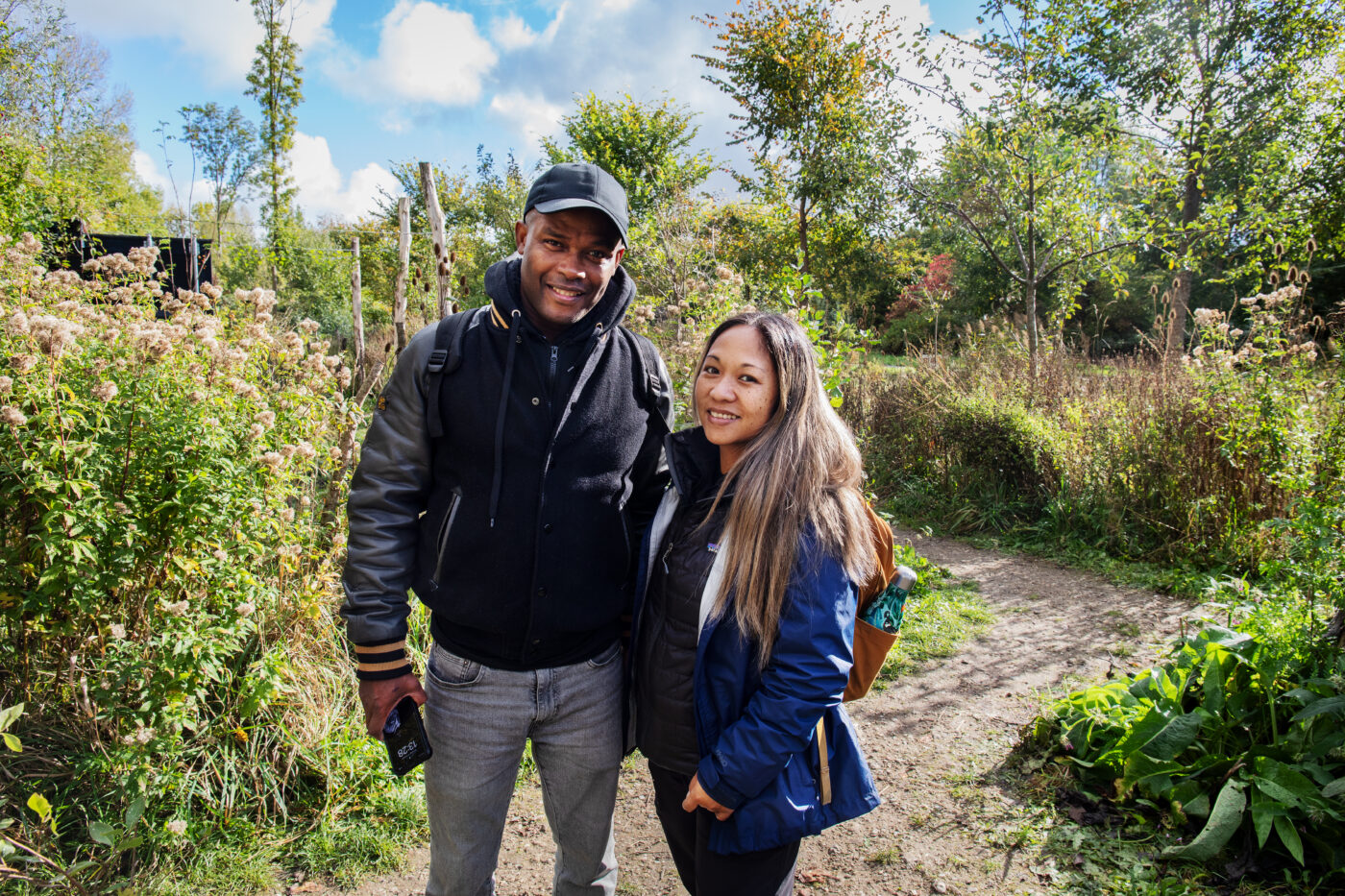
After a period of slowing down, experiencing, and exploring, it is time to look back—and ahead—with artist Faisel Saro and “awareness facilitator” Marrigt van der Valk.
The Genius Loci living lab brings art, nature, and inclusion together in the Leeuwarder Forest. In this special collaboration between VHDG, Kunstkade, and Oerol, more than one hundred students from ISK and Ynsicht take part in a shared process of research and creation. The past period was dedicated to getting acquainted, experiencing, and slowing down. Now it is time to reflect—and to look forward.
Looking back – surprises in the forest
What stands out most when we look back on the first weeks is how open and curious the students ultimately proved to be. Some young people started out with the idea that nature was “not for them.” It was precisely these students who later said how much they enjoyed being outdoors: the quiet, the walking, and especially the encounter with the Scottish Highland cattle left a strong impression. During the joint research in the Leeuwarder Forest, many students visibly began to open up, Faisel explains. This was helped by the fact that we introduced ourselves in the classroom. “Our unique, personal, and vulnerable presentations had a good and positive impact on the students.”
The process of discovering together also yielded insights. In large groups, it sometimes proved difficult to make genuine contact. But while walking—one on one—unexpectedly personal and deep conversations emerged. The forest offered space for stories that might not naturally arise in a classroom.
One important insight was the importance of safety and time. In a group of young people, social pressure is always present. By not setting the bar too high at the outset and by not focusing on “performance” or “production,” space was created to first explore and get to know one another. That approach—setting out together without haste—worked. Trust grew, and with it the willingness to show something of yourself.
Interim period – reflection and growth
After this intensive start, an interim period has now begun: a moment to catch one’s breath and turn inward for a while. At the same time, new ideas are already bubbling up.
What came through strongly is how differently students experience the forest. For some, it evokes memories of home: the vast forests of Ukraine, where nature is taken for granted. For others, the forest symbolizes danger, recalling places where poisonous or wild animals live. Still others experience the forest as a place of peace and freedom—or, conversely, as a reminder of compulsory hiking holidays. These varied perspectives form a rich foundation for what comes next.
The differences between ISK and Ynsicht students—in background as well as in their relationship to nature—are not something to be bridged, but something that deepens the project. This diversity of meanings will be carried into the next phase.
Looking ahead – from experiencing to making
In the coming months, the living lab will gradually shift toward making. After a fresh restart in February, participants will search for symbols, images, and forms that resonate with their experiences. Mood boards, sketches, and experiments will serve as stepping stones toward concrete work.
Faisel and Marrigt are looking forward to the moment when everything comes together: personal stories, experiences of nature, and artistic imagination. The hope is that students—and the public as well—will experience how art can be a way to connect with a place and with one another. “I am convinced that there is an artist hidden inside everyone,” says Marrigt.
Faisel further emphasizes how important it is that students continue to encounter art and nature in an accessible way, always starting from their own experiences. “It is precisely those personal experiences that drive the project. At a time when there seems to be less and less space and attention for nature and art, this living lab deliberately chooses to slow down and go deeper. It’s not about immediate results, but about planting seeds.”
From the Leeuwarder Forest to Oerol
In May 2026, the students will present their artworks in the Leeuwarder Forest, at the place where their research began. One month later, they will travel to Oerol on Terschelling, where they will experience art, theatre, and nature during a guided nature walk and a theatre performance. There, they will also look back on their own work and process. In this way, Genius Loci connects the Leeuwarder Forest with Oerol: from making in nature to experiencing on a larger scale.
Genius Loci is made possible in part by a contribution from the Cultuurfonds.